Culture as a Safety System
My first clear example of how organizational culture can be a decisive contributor to success came when I was still a student.
I learned to fly at a long-established gliding (soaring) club and, before heading off to college, earned my instructor rating there. As a young flight instructor, I began to notice a pattern: some long-time members engaged in what I would politely describe as safety-challenged operations. What struck me most was not the behavior itself, but how the organization responded to it.
The prevailing culture was to grimace behind the perpetrator’s back rather than confront the individual directly. Seniority carried unspoken privileges, and a hierarchy discouraged open communication—especially when near-incident situations arose. Concerns were observed, discussed privately, and quietly set aside rather than addressed head-on.¹
Later, as an undergraduate, I helped form a soaring club at Princeton University, working alongside Evan Flatow and Marina Schaum. In the early days, there was a single instructor—me—and roughly 80 students. Over time, we trained additional instructors from within that initial student group, including Steve Gervin, Mark Maughmer, Wally Hayes, and Martin Scheiderman.
One of those early students was Brian Binnie, with whom I soloed at Princeton and later examined for his first pilot certificate check ride.
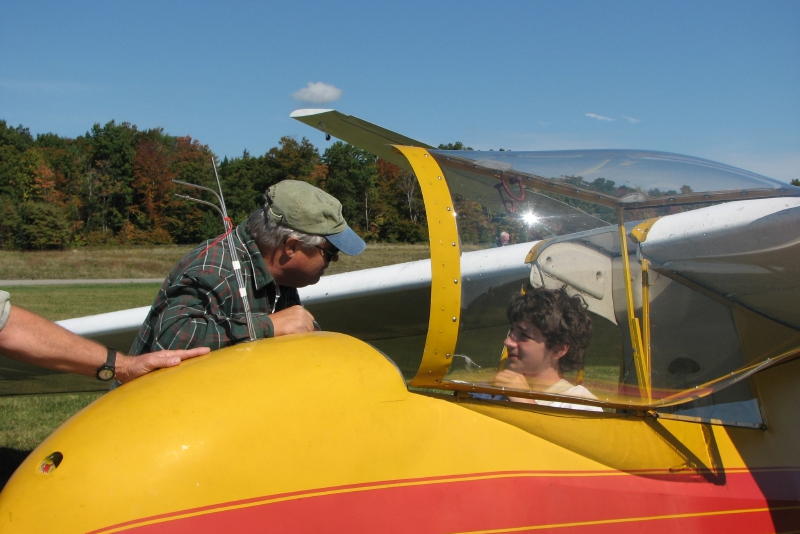
At the start, we operated with just one two-place trainer, a venerable Schweizer 2-22E. Soon after, we added a single-seat Schweizer 1-26D so newly soloed pilots could build time toward their licenses and enjoy independent soaring. Along with the aircraft, we introduced a simple but powerful rule:
Every non-instructional flight would be critiqued by the instructor on duty.
At first, this was easy—I was the instructor for every student. As more pilots earned their licenses and flew independently, the critiques became more frequent, and eventually, I found myself on the receiving end of feedback as well.
The process was straightforward. A pilot would launch on a solo or non-instructional flight. The instructor on duty would keep an eye on the flight, even while managing other responsibilities. After landing, the pilot would actively seek out the instructor for feedback.
The critiques were direct, specific, and constructive:
-
“Good flight, but you got a little too far downwind searching for lift. Winds can shift during the flight—leave yourself more margin.”
-
“You came in a bit slow on final. Watch your airspeed as you enter the wind gradient close to the ground.”
-
“I noticed you were working the downwind side of the cumulus clouds. Today, the thermals were forming on the upwind side. Start with wider search patterns until you understand the day’s conditions.”
This routine created a healthy learning environment, and the club developed an excellent safety record.
The real strength of the culture became clear only after I had graduated.
I returned to the soaring field some time later and was barely recognized—most of the students and staff on duty were new. That day, a senior pilot completed a flight and went in search of feedback. He approached the instructor on duty, who was younger and junior in both age and club seniority. The instructor replied that he had been busy with a student and hadn’t been able to observe the flight.
“Hope it was a good one,” he said.
The senior pilot was furious.
He explained that he paid good money to belong to the club and to fly there, and that he expected to be critiqued on every flight. He lived some distance away, and one of the main reasons he chose this club was precisely because it ensured continuous improvement through feedback. He told the instructor that providing critique was part of the instructor’s responsibility—and that if this expectation wasn’t met, he would raise the issue with the club officers.
I was stunned—in the best possible way.
Not only had the culture of open communication survived my departure, but it had become so deeply ingrained that even the most senior pilots viewed critique as a core value rather than a personal affront. It wasn’t just tolerated—it was demanded.
I couldn’t have been prouder.
Culture, when intentionally designed, can reinforce performance objectives, enhance safety, and become a central part of an organization’s value proposition.
¹ This prestigious glider club later recognized its cultural shortcomings and undertook several intervention cycles to address safety concerns. My understanding is that they have since adjusted their culture successfully for new members and students.

Share this Post