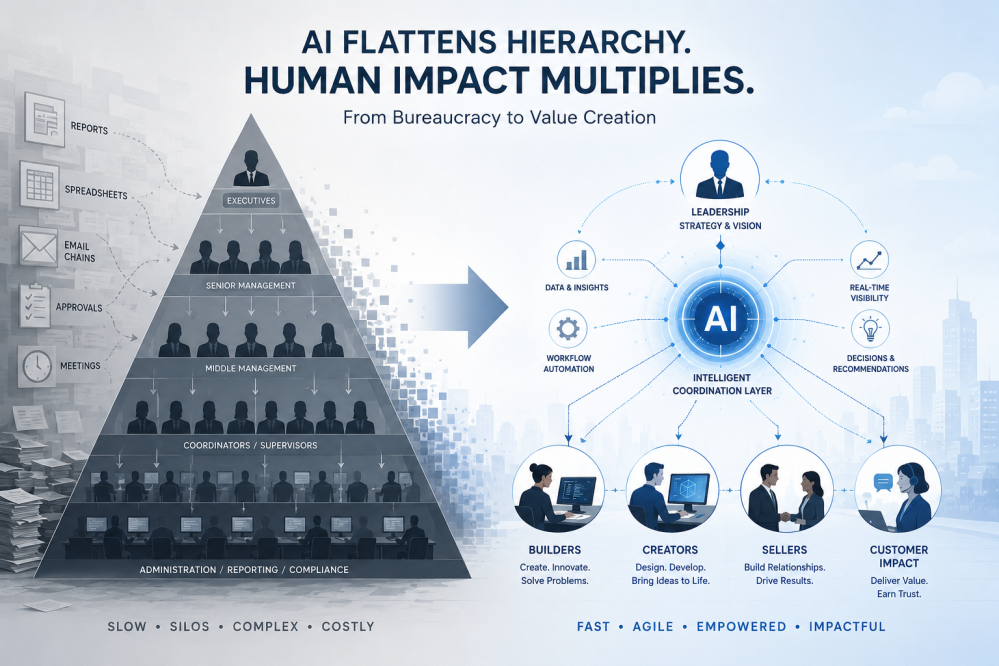
Why Artificial Intelligence May Flatten Organizations While Increasing the Value of Human Creativity
Two weeks ago, Cloudflare CEO Matthew Prince announced that the company had laid off more than 20% of its workforce—even while posting record growth and strong cash flow. At first glance, the move sounded like a familiar Silicon Valley story about cost-cutting and automation. But Prince framed it very differently.
Cloudflare, he argued, was not shrinking. It was restructuring for an AI-driven future. The company still plans to grow and continues hiring aggressively. The difference is where it intends to invest human talent.
To explain the shift, Prince reached back to Peter Drucker’s 1954 classic The Practice of Management, dividing organizations into three categories of workers:
- Builders — those who create products and services
- Sellers — those who build relationships and generate revenue
- Measurers — those who coordinate, report, audit, monitor, approve, summarize, and manage organizational processes
Prince’s thesis is provocative but increasingly difficult to dismiss:
AI is not primarily replacing builders and sellers.
It is compressing the “measuring” layer of organizations.
That idea aligns remarkably well with broader industry research. Deloitte’s 2026 State of AI in the Enterprise report suggests organizations are entering a phase where AI is moving beyond experimentation and beginning to reshape operating models, managerial structures, and workflows at enterprise scale.
The implications are enormous.
This may not simply be another technology cycle. It may represent a structural reduction in organizational bureaucracy—and a dramatic increase in the value of people who directly create value.
Why Bureaucracy Existed in the First Place
For most of modern business history, organizations became hierarchical for a simple reason: information moved slowly.
Managers existed partly because:
- executives could not directly observe frontline operations,
- reporting required manual consolidation,
- coordination required meetings and approvals,
- and communication bandwidth was limited.
Middle management became the “translation layer” of the enterprise.
Someone had to:
- summarize status,
- reconcile spreadsheets,
- prepare reports,
- monitor compliance,
- coordinate schedules,
- allocate resources,
- and carry information up and down the organizational chain.
In large organizations, this coordination layer became massive.
Much of the corporate world evolved around what might be called administrative synchronization. Entire departments emerged whose primary function was not creating products or serving customers, but rather measuring, tracking, auditing, documenting, and managing the activities of others.
That structure made sense when information was fragmented and expensive to process.
But AI changes the economics of coordination.
AI as the Great Organizational Compressor
Modern AI systems can instantly:
- summarize operational status,
- generate reports,
- monitor KPIs,
- identify anomalies,
- coordinate workflows,
- route approvals,
- draft communications,
- and synthesize organizational data in real time.
Tasks that once required multiple organizational layers increasingly become software functions.
Cloudflare’s restructuring reflects exactly this shift. Prince specifically cited reductions in:
- middle management,
- operations,
- finance coordination,
- and administrative marketing functions.
Importantly, Cloudflare is not alone.
The Deloitte report found that organizations are rapidly moving from AI pilots into enterprise deployment:
- workforce access to AI tools has expanded by roughly 50% in a year,
- 54% of organizations expect large-scale production deployment within six months,
- and nearly three-quarters expect widespread deployment of agentic AI within two years.
The result is not merely automation of tasks. It is organizational compression.
A Google AI synthesis referencing commentary from LinkedIn, Reddit, and business analysts described AI as flattening hierarchies by automating “data consolidation, reporting, and information-shuttling tasks historically handled by middle managers.”
In practical terms:
- dashboards replace status meetings,
- AI summaries replace manual reporting,
- workflow systems replace coordination overhead,
- and executives increasingly gain direct visibility into operations without multiple interpretive layers.
This changes managerial span dramatically.
If AI handles routine coordination, one leader can oversee significantly more people. Deloitte notes that many organizations are already exploring flatter and more pod-based organizational structures.
The result may be what some executives are calling “unbossing”:
fewer layers,
fewer administrative intermediaries,
and more direct connection between leadership and value creators.
The Most Valuable Humans Become Even More Valuable
Ironically, the rise of AI may increase the importance of highly capable humans rather than diminish it.
Prince’s distinction between builders, sellers, and measurers is important because it clarifies where human leverage still matters most.
If a software engineer becomes 5–10 times more productive with AI assistance, organizations do not necessarily need fewer great engineers. They may want more of them.
The same applies to:
- product designers,
- inventors,
- entrepreneurs,
- strategists,
- scientists,
- negotiators,
- and elite sales professionals.
AI amplifies output.
That means organizations increasingly reward:
- judgment,
- creativity,
- adaptability,
- customer empathy,
- and domain expertise.
Deloitte’s research strongly supports this view. One executive interviewed in the report described AI not as replacing workers, but as creating “force multipliers where they can be more effective.”
This distinction matters enormously.
The popular narrative around AI often assumes widespread human obsolescence. But in many knowledge industries, the near-term reality may be quite different:
- fewer coordinators,
- fewer administrative translators,
- but greater productivity from high-value creators.
Organizations that understand this dynamic may become dramatically more effective.
Rather than adding management layers to coordinate growing complexity, they can use AI to absorb much of that coordination overhead directly.
The Hidden Problem: Where Future Leaders Come From
There is, however, a serious complication.
Historically, many entry-level corporate roles served as training grounds.
Analysts,
coordinators,
junior associates,
and operations staff often learned the mechanics of organizations by performing repetitive administrative tasks before advancing into leadership roles.
But Deloitte warns that these very jobs are among the first being targeted for automation.
That creates a potentially profound organizational challenge:
How do companies develop future leaders if traditional apprenticeship pathways disappear?
If AI eliminates:
- reconciliation work,
- basic reporting,
- first-level analysis,
- routine customer support,
- and administrative coordination,
then organizations may lose the developmental ladder that historically trained management talent.
This could produce an unexpected paradox:
AI may increase productivity while simultaneously weakening long-term leadership pipelines.
Companies will likely need to redesign career development entirely.
Future leaders may need to gain experience through:
- rotational assignments,
- AI-supervised operational environments,
- strategic project work,
- and earlier exposure to higher-order decision-making.
The organizations that solve this problem well may enjoy a major competitive advantage over those that merely eliminate headcount.
Governance Still Matters
Another misconception surrounding AI is that organizations can simply “hand over” operations to autonomous systems.
The reality is more nuanced.
Deloitte found that while nearly 74% of organizations expect significant adoption of agentic AI within two years, only 21% currently report mature governance structures for autonomous systems.
That gap is dangerous.
AI can scale not only productivity, but also mistakes.
Poor assumptions,
bad data,
security vulnerabilities,
or flawed incentives can propagate rapidly through automated systems.
This means humans remain essential for:
- accountability,
- oversight,
- ethical judgment,
- exception handling,
- and strategic decision-making.
In many ways, the managerial role may not disappear—it may evolve.
The surviving human manager increasingly becomes:
- coach,
- strategist,
- mentor,
- escalation point,
- and guardian of judgment.
AI may handle coordination and analysis. Humans still handle ambiguity and responsibility.
From Incremental Efficiency to Strategic Reinvention
The deeper story here is not merely labor reduction.
It is organizational redesign.
Deloitte repeatedly emphasizes that the highest-performing organizations are not simply automating existing processes. They are reimagining how work itself should function in an AI-native environment.
That distinction is critical.
Many companies will use AI primarily as a cost-saving tool:
- automate reports,
- reduce support staff,
- trim middle management,
- improve efficiency.
But the more transformative organizations may go much further:
- redesign operating structures,
- flatten hierarchies,
- accelerate decision-making,
- increase employee leverage,
- and redirect talent toward innovation and customer value creation.
In that world, organizational success becomes less about administrative scale and more about:
- adaptability,
- speed,
- creativity,
- and strategic clarity.
The premium shifts toward people who directly create or capture value.
The New Scarcity
For decades, information processing and organizational coordination were scarce resources.
That scarcity justified large bureaucratic structures.
AI changes that equation.
The new scarcity may instead become:
- creativity,
- trust,
- judgment,
- leadership,
- domain expertise,
- and human relationship skills.
Organizations that recognize this shift early may become dramatically more productive—not simply because they reduce costs, but because they free talented people from bureaucratic drag.
The companies that thrive in the next decade may not be those that eliminate the most jobs.
They may be the ones that most effectively:
- compress bureaucracy,
- flatten decision chains,
- empower builders,
- amplify sellers,
- and redesign work around uniquely human strengths.
In that sense, AI may ultimately prove less important as an automation technology than as an organizational one.
And if Matthew Prince is correct, the biggest disruption ahead may not be the elimination of work itself—but the decline of the measuring class that once held modern corporate bureaucracy together.
References
- Matthew Prince, “How I Choose Which Cloudflare Employees to Replace With AI,” Wall Street Journal, 2026. (Attached source article)
- Deloitte, State of AI in the Enterprise: The Untapped Edge, January 2026.
- Google AI synthesis referencing LinkedIn, Reddit, Gartner, and Harvard Business Review discussions regarding AI-driven flattening of organizational hierarchies and middle management restructuring. (Attached research summary)
- Peter Drucker, The Practice of Management, 1954.

Share this Post